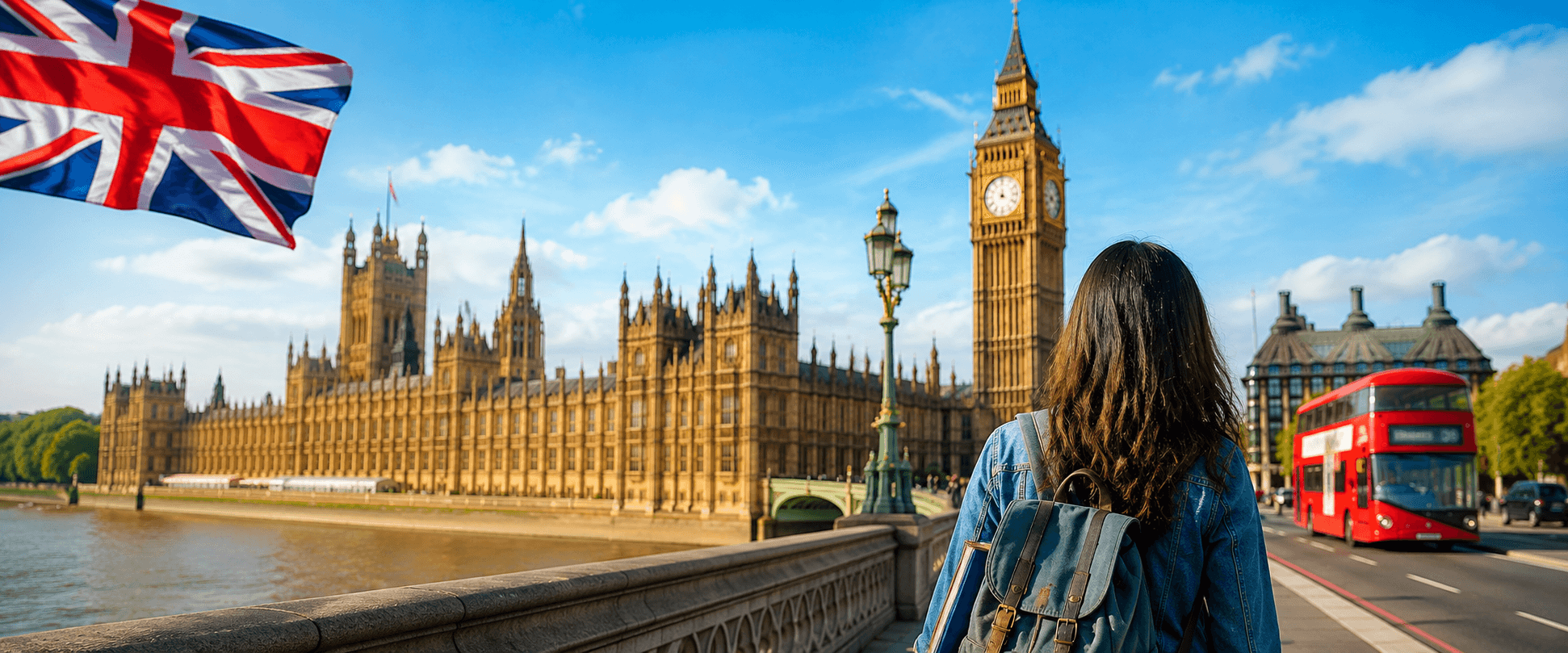

Study in UK from Sri Lanka: Your Complete 2026 Guide
Yes, Sri Lankan students can study in the UK — and thousands do every year, across 3-year bachelor's degrees, 1-year master's programmes, and everything in between. The process comes down to four things: getting an offer from a licensed UK institution, showing you meet the entry requirements, proving you can afford the course and your living costs, and applying for a Student visa. Budget roughly £10,000–£38,000 a year in tuition depending on your course, plus visa costs, and expect the whole journey — from choosing a course to landing in the UK — to take around 6 to 9 months from start to finish.
This guide walks through universities, costs, and visa requirements in detail, with numbers converted into terms that make sense if you're planning from Colombo, Kandy, or anywhere else in Sri Lanka.
Why Sri Lankan Students Choose the UK
A few practical reasons keep the UK near the top of the list for Sri Lankan students, alongside destinations like Australia and Canada.
UK bachelor's degrees typically take three years instead of four, and master's degrees usually take just one year — which can mean lower total tuition and living costs even if the annual fee looks similar to other countries. UK qualifications are also widely recognised by employers in Sri Lanka and internationally, which matters if you're planning to return home or work abroad after graduating.
There's also an established path to work in the UK after finishing your degree, through the Graduate Route visa (more on that below), and a large, well-connected Sri Lankan student community at universities across the UK, from Colombo school alumni networks to Sri Lankan societies on campus.
None of this makes the UK automatically the "right" choice — that depends on your course, budget, and goals — but it explains why it consistently ranks as one of the top three destinations Sri Lankan students research.
UK Universities for Sri Lankan Students
How to choose a university
Three things matter more than overall ranking: whether the specific course is strong at that university, whether the city fits your budget, and whether the university has a track record of supporting Sri Lankan or South Asian students. A university ranked 20th overall might have a mediocre business school, while one ranked 60th might be genuinely excellent for accounting and finance. Course-level league tables (available on sites like The Complete University Guide) are more useful than overall institution rankings for this reason.
.
Popular course areas among Sri Lankan students
Business and Management, Engineering, Computing and Data Science, Law, and Health Sciences are consistently the most popular subject areas for Sri Lankan applicants, partly because they map onto strong local job markets in Sri Lanka and partly because of clear career pathways in the UK itself.
.
Entry requirements, explained in Sri Lankan terms
For undergraduate courses, UK universities generally look for the equivalent of three GCE Advanced Level passes, with the specific grades depending on the course and university — competitive courses like Medicine or Law at higher-ranked universities ask for closer to three As, while many good universities accept BBB or BBC. If your A/L results don't quite meet a university's direct-entry requirement, a foundation year (an extra preparatory year before the degree starts) is a common and normal route in — not a downgrade, just a different timeline.
For postgraduate courses, you'll typically need a bachelor's degree with a second-class upper (2:1) or equivalent, though requirements vary by course and some universities accept a 2:2 with relevant work experience.
Almost every course also requires proof of English proficiency, usually an IELTS for UKVI score of 6.0–6.5 overall for undergraduate study and 6.5–7.0 for postgraduate study, though this varies by university and course.
A worked example: Say a student completes the A/L Commerce stream with a C, C, S. A direct Business Management degree at a mid-tier UK university might ask for BBB — out of reach with those grades. But the same student could apply for a one-year foundation programme in Business, attached to that university, which leads directly into year one of the degree if they pass. Total time to a UK business degree: four years instead of three, but the door is still open.
Cost of Studying in the UK
This is usually the first real gatekeeping question for Sri Lankan families, so here's the honest breakdown — tuition, living costs, and the one-off costs people forget.
.
Tuition fees
| Undergraduate (most courses) | £10,000 – £38,000 |
| Postgraduate taught (Master's) | £11,000 – £32,000+ |
| MBA / specialist postgraduate | Can exceed £35,000 |
Universities in London, Oxford, and Cambridge sit at the higher end; universities in cities like Manchester, Leeds, Glasgow, and Nottingham are often noticeably more affordable without a drop in course quality. It's worth comparing course fees across three or four universities before assuming a "top name" is out of reach — the fee difference between a well-regarded London university and an equally well-regarded regional one can be substantial.
.
Living costs
Living costs depend heavily on location, and the UK Home Office effectively sets a benchmark for this through the visa's financial requirement: students studying in London need to show they can cover £1,529 a month, and students outside London need to show £1,171 a month, each capped at nine months of the course. That's a reasonable proxy for what students actually spend — expect rent to be the largest single cost, followed by food, transport, and phone/internet.
.
Costs people forget to budget for
Student visa application fee: £558
Immigration Health Surcharge (IHS): £776 per year of your visa, paid upfront in full for the whole course length
University deposit to confirm your place (varies by university, often £1,000–£3,000, usually deducted from your first year's tuition)
Flights and initial settling-in costs (SIM card, bedding, winter clothing if arriving in autumn)
For a three-year undergraduate degree, visa fee plus IHS alone comes to roughly £3,274 per student, before a single pound of tuition or living costs — worth building into your total budget conversation early rather than discovering it during the visa application.
.
Ways to reduce the cost
Scholarships won't cover everyone, but they're worth investigating properly rather than dismissing. Chevening Scholarships (UK government-funded, fully covering tuition, living costs, and flights for one-year master's degrees) are open to Sri Lankan applicants and are genuinely competitive but real — Sri Lanka is an eligible Chevening country. GREAT Scholarships offer £10,000 toward tuition at a number of partner universities. Commonwealth Scholarships fund full master's and PhD study for students from Commonwealth countries, including Sri Lanka, with a focus on development-relevant fields. Many universities also run their own merit-based scholarships specifically for international undergraduates, typically £2,000–£8,000 a year.
These are competitive, merit-based awards — worth applying for, but not something to bank on as your funding plan. Treat them as a possible reduction, not the basis of your budget.
UK Student Visa Requirements for Sri Lankans
Sri Lankan nationals need a Student visa (sometimes still called the Tier 4 visa, though that name was phased out) to study a course longer than six months in the UK. Here's what the application actually requires.
.
The core checklist
A CAS (Confirmation of Acceptance for Studies) from a UK institution holding a valid student sponsor licence — you can only apply for the visa after you've accepted an offer and the university has issued this
Proof of funds covering your remaining tuition (as shown on the CAS) plus £1,529/month (London) or £1,171/month (outside London) for up to nine months, held in your or your parent's bank account for 28 consecutive days before applying
Proof of English proficiency, usually an approved IELTS for UKVI test, unless you're exempt (for example, if your previous qualification was taught in English)
Academic qualification documents matching what your CAS references
A TB test certificate, since Sri Lanka is on the UK's list of countries where this is required
Parental consent and relationship documents, if you're under 18
What it costs
Visa application fee: £558
Immigration Health Surcharge: £776 per year of your visa, paid in full upfront
How the process actually flows
Accept your university offer and receive your CAS
Gather and organise your financial and academic documents
Complete the online Student visa application and pay the fee and IHS
Book and attend a biometric appointment at a UK visa application centre in Sri Lanka
Wait for a decision — UKVI's standard processing time is around three weeks from Sri Lanka, though it can vary
Realistically, start this process at least two to three months before your course start date to leave room for appointment availability and any follow-up requests from UKVI.
Why applications get refused — and how to avoid it
Sri Lankan Student visa applications have a strong overall approval rate, and most refusals come down to a small, predictable set of issues rather than bad luck:
Financial documents that don't meet the exact rules — funds not held for the full 28 days, a bank statement dated too far before submission, or a shortfall against the required amount. This is the single most common and most avoidable reason for refusal.
Incomplete or inconsistent documents — names, dates, or amounts that don't match across your CAS, bank statements, and application form.
Weak evidence of genuine intent — not clearly explaining how the course connects to your academic background and future plans.
English test scores below the required band, or an expired or non-UKVI-approved test.
None of this is about "impressing" the visa officer — it's about submitting a complete, accurate, well-documented application that matches what UKVI's rules actually ask for. Careful preparation meaningfully reduces the risk of a documentation-based refusal, though it can't guarantee a specific outcome, since each application is individually assessed.
After You Arrive: Working and Staying On
A Student visa allows most students to work part time during term (typically up to 20 hours a week for degree-level courses) and full-time during official holidays — useful for covering some living costs, though it shouldn't be relied on to fund your studies.
After graduating, eligible students can apply for the Graduate Route visa, which currently allows two years of work or job-seeking in the UK without needing a job offer or employer sponsorship (three years for PhD graduates), for applications made on or before 31 December 2026. Immigration rules do change, so it's worth confirming the current terms on gov.uk close to when you'd actually apply, rather than planning years ahead around today's rules.
How to Start Your Application from Sri Lanka: A Simple Roadmap
Research courses and shortlist universities based on your grades, budget, and career goals
Apply directly or through UCAS (for most undergraduate courses)
Receive your offer and CAS once you've accepted a place and met any conditions
Arrange your funds early, since the 28-day holding rule needs planning ahead
Apply for your Student visa and book your biometric appointment
Prepare for departure — accommodation, flights, and orientation
Each of these steps has its own detail and its own way to go wrong — which is exactly where having someone check your shortlist, your documents, and your visa application before you submit tends to save the most time and stress.
.
Frequently Asked Questions
How much does it cost to study in the UK from Sri Lanka?
Tuition typically runs £10,000–£38,000 a year depending on the course and university, plus living costs of roughly £1,171–£1,529 a month depending on the city. Add the one-off visa fee (£558) and Immigration Health Surcharge (£776/year of your visa) on top.
Can Sri Lankan students get a UK study visa easily?
Sri Lankan applicants generally see a strong approval rate when applications are complete and well-documented. Most refusals come from avoidable issues like incomplete financial evidence rather than nationality-based restrictions — but no application's outcome can be guaranteed in advance.
What A/L grades do I need to study in the UK?
It depends on the course and university — competitive courses at higher-ranked universities may ask for close to three As, while many good universities accept BBB or BBC. If your grades fall short of a direct-entry requirement, a foundation year is a common route in.
Do I need IELTS to study in the UK?
Most universities require an IELTS for UKVI score, usually 6.0–6.5 for undergraduate courses and 6.5–7.0 for postgraduate courses, though some universities accept alternative proof of English proficiency or offer exemptions.
How long does a UK student visa take to process from Sri Lanka?
UKVI's standard processing time from Sri Lanka is around three weeks, though it's sensible to apply at least two to three months before your course starts to allow for appointment scheduling and any additional checks.
Can I work while studying in the UK on a student visa?
Most degree-level students can work up to 20 hours a week during term time and full-time during official holidays, though specific conditions depend on your course level and visa terms.
What happens after I graduate — can I stay and work in the UK?
Eligible graduates can apply for the Graduate Route visa, currently offering two years of work or job-seeking without needing employer sponsorship (three years for PhD graduates). Confirm the current rules on gov.uk when you're closer to applying, as immigration policy changes over time.
Is it cheaper to study in the UK than Australia or Canada for Sri Lankan students?
It depends on the course and city, but the UK's shorter course lengths — three years for a bachelor's, one year for most master's — can offset a similar or slightly higher annual fee compared to some other destinations. A direct comparison is worth doing course-by-course rather than assuming one country is cheaper across the board.
Can I get a scholarship as a Sri Lankan student?
Yes — options include Chevening Scholarships, GREAT Scholarships, Commonwealth Scholarships, and university-specific awards. These are competitive and merit-based, so they're worth applying for as a way to reduce costs, but shouldn't be treated as guaranteed funding.
Ready to Plan Your Next Step?
Studying in the UK from Sri Lanka is a well-worn path, but getting the details right — the right course match, an accurate budget, a clean visa application — is where most of the stress happens. If you'd like a second pair of eyes on your shortlist or your documents, Next Level Education offers free consultations to help Sri Lankan students plan their UK application with confidence, at your own pace.